Which alternate guitar tunings do songs use? We analysed 2,808 songs
Most songs are played in standard tuning. This study is about the rest: we took every song in our database that is not in standard E-A-D-G-B-E, grouped them by the pitches their strings are actually tuned to, and counted which alternate tunings guitarists use, which strings they change and how far they go.
By Moritz Schoeberichts · Published · Updated · Data as of
Key findings
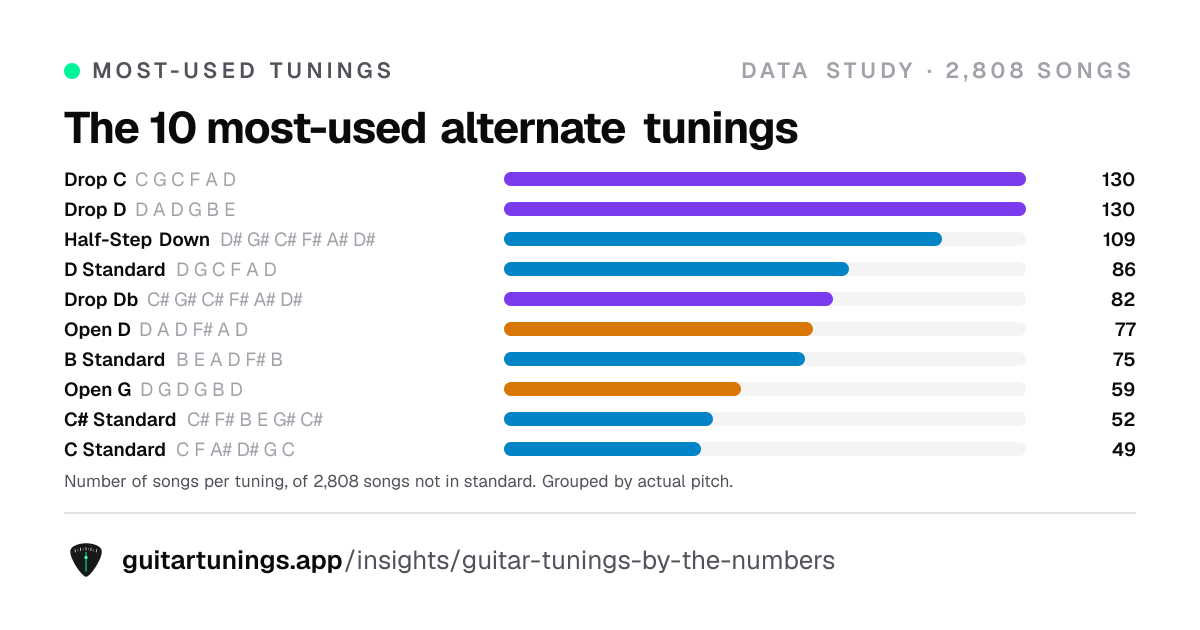
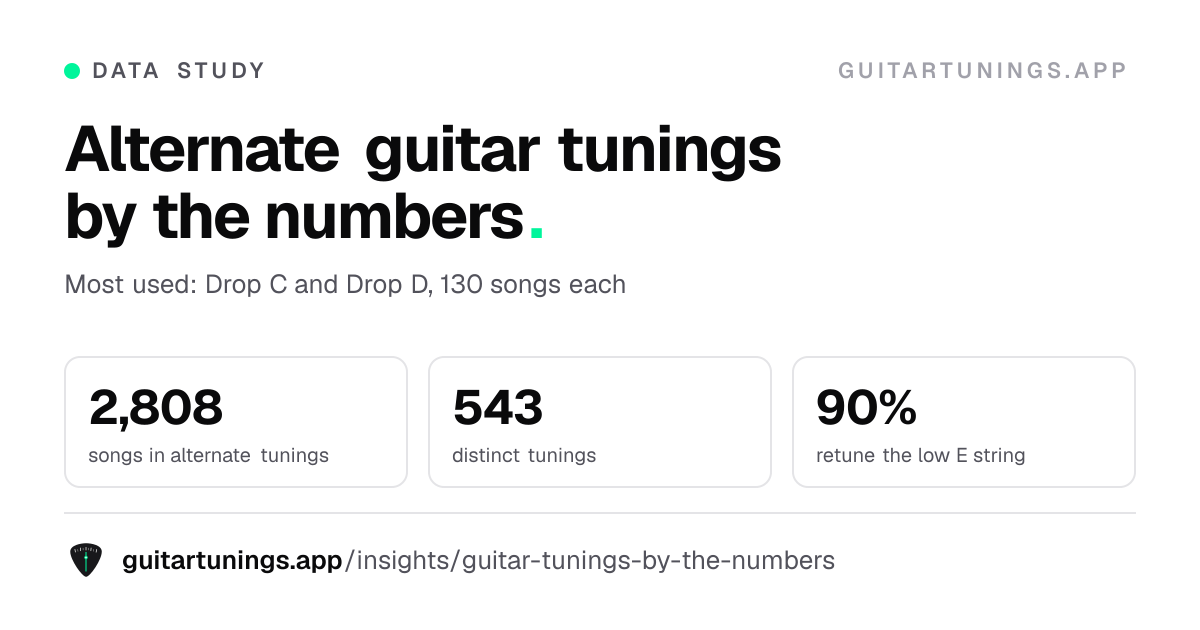
- Drop C and Drop D tie as the most-used alternate tunings, with 130 songs each.
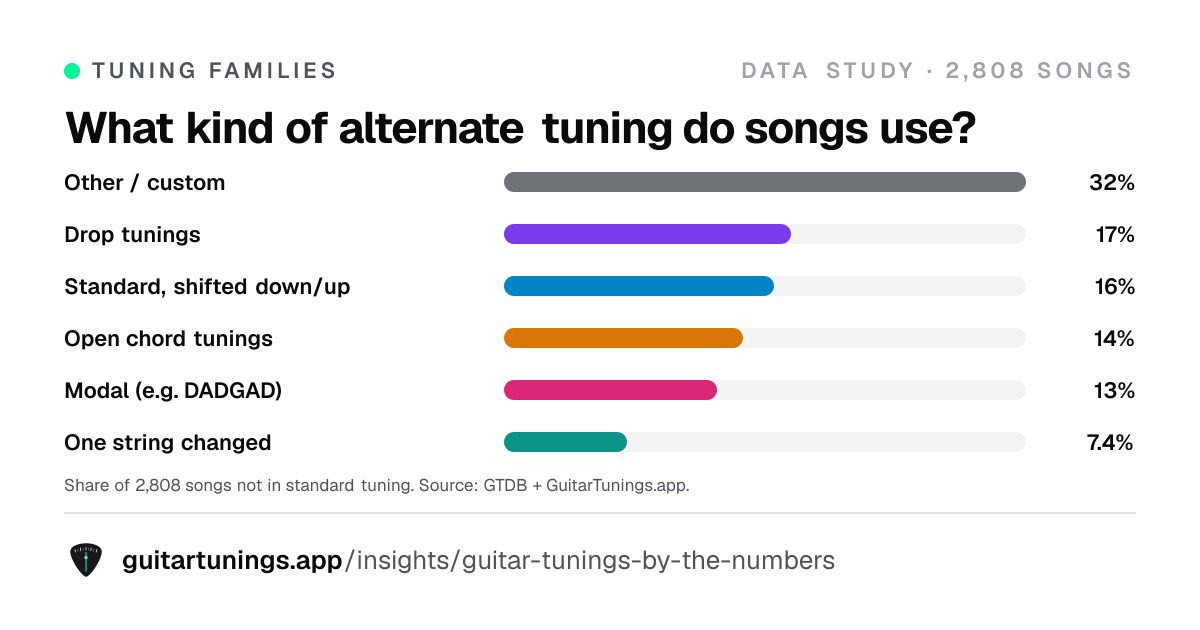
- Drop tunings (17%) and standard tuning moved down or up as a whole, like Eb or D standard (16%) are the largest families. 14% use an open chord tuning, 13% a modal tuning like DADGAD, and 32% a less common tuning that fits no family.
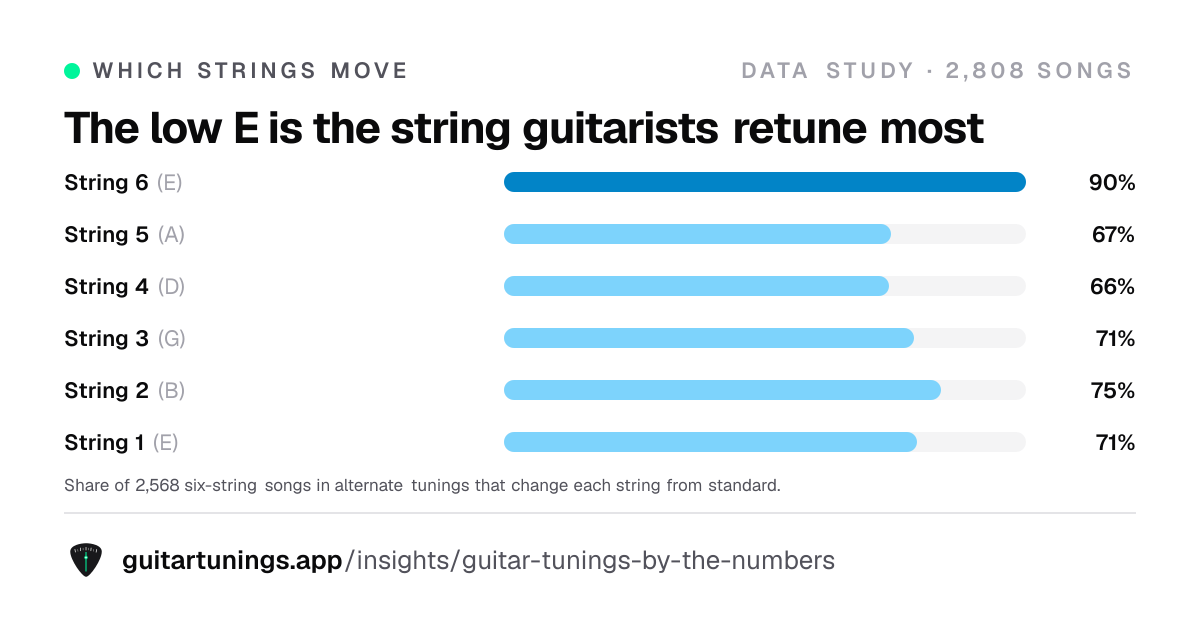
- 90% of six-string songs in alternate tunings retune the low E string. The next most-retuned string, the B (string 2), changes in 75%.
- 73% only tune strings down; just 5.3% only tune up.
- 34 tunings cover half of all songs, while 49% of the 543 distinct tunings are used by a single song.
Free to quote and republish with a link to this page. Charts, embed code and a citation are in Use the data.
Key numbers
Drop, open, DADGAD or something else?
- Standard, tuned down or up (e.g. Eb, D)16% · 459
- Drop tunings17% · 487
- One string changed (e.g. AADGBE)7.4% · 209
- Open chord tunings14% · 406
- Modal / suspended (e.g. DADGAD)13% · 361
- Other / custom32% · 886
The two simplest moves account for a third of all songs: dropping the low string a whole step (drop tunings, 17%) and tuning every string down by the same amount, as in Eb or D standard (16%). A further 7.4% change just one string in some other way, like AADGBE or EADGBD. Open chord tunings such as Open G and Open D make up 14%, and modal tunings like DADGAD 13%. The largest slice, 32%, fits none of these patterns: it is spread over 332 different tunings, from double drop D to tunings written for a single song.
The 15 most-used alternate tunings
- Drop C TuningC G C F A D130 · 4.6%
- Drop D TuningD A D G B E130 · 4.6%
- Half-Step Down / Eb StandardD# G# C# F# A# D#109 · 3.9%
- D Standard / Whole-Step DownD G C F A D86 · 3.1%
- Drop Db / Drop C#C# G# C# F# A# D#82 · 2.9%
- Open D TuningD A D F# A D77 · 2.7%
- B Standard / BaritoneB E A D F# B75 · 2.7%
- Open G TuningD G D G B D59 · 2.1%
- C# Standard TuningC# F# B E G# C#52 · 1.9%
- C Standard TuningC F A# D# G C49 · 1.7%
- DADGAD Celtic TuningD A D G A D44 · 1.6%
- Drop B TuningB F# B E G# C#39 · 1.4%
- Never Meant / Midwest EmoF A C G C E34 · 1.2%
- Open C TuningC G C G C E34 · 1.2%
- Name Alt-TuningD A E A C# E28 · 1.0%
Drop C and Drop D tie as the most-used alternate tunings, with 130 songs each. Most of the list keeps standard’s intervals and simply goes lower: Eb, D, C# and C standard, B standard and the drop tunings. Open D, Open G, DADGAD and Open C are the main exceptions. Bar colours match the families above.
A very long tail
A small set of tunings does most of the work: the top 15 cover 37% of songs. Beyond that the data fragments quickly. 49% of all distinct tunings are one-offs, used by a single song each, often a songwriter’s own invention.
Which strings get retuned?
- String 6 (E)lowest90% · 2,316
- String 5 (A)67% · 1,715
- String 4 (D)66% · 1,706
- String 3 (G)71% · 1,821
- String 2 (B)75% · 1,938
- String 1 (E)highest71% · 1,834
The low E is the string guitarists reach for first: 90% of songs change it. Every other string moves in roughly two to three songs out of four, mostly because shifted tunings like Eb standard move all six. The least-changed string is the D (string 4, 66%).
Retuning is overwhelmingly a downward move. Lower tension is easier on the strings and the fingers, and lower pitches are what heavier styles want. Tuning up is rare on its own and usually appears together with other strings going down, as in open and modal tunings.
How many strings change?
Strings retuned from standard
On average a six-string song in an alternate tuning changes 4.4 of its 6 strings. The spike at six comes from shifted tunings like Eb and D standard, where every string moves; the bump at one is mostly Drop D. 41% keep every string within a whole step (2 semitones) of standard pitch, so most alternate tunings are a small adjustment, not a re-stringing job.
How low does the lowest string go?
- E312 semitones higher0.1% · 2
- G23 semitones higher1.7% · 43
- F#22 semitones higher1.1% · 29
- F21 semitone higher3.4% · 88
- E2as in standard9.8% · 252
- D#21 semitone lower5.6% · 143
- D22 semitones lower32% · 819
- C#23 semitones lower9.5% · 243
- C24 semitones lower19% · 480
- B15 semitones lower9.0% · 232
- A#16 semitones lower3.4% · 88
- A17 semitones lower4.0% · 102
- G#18 semitones lower1.8% · 47
84% of these songs put the lowest string below standard E2. The most common lowest note is D2 (32%), the bottom string of Drop D, D standard, Open D, Open G and DADGAD. A further 226 songs are on 7- or 8-string guitars and are not included in this chart.
Artists with the most distinct tunings
- Nick Drake34 songs17 tunings
- The Tallest Man on Earth28 songs17 tunings
- Joni Mitchell31 songs15 tunings
- Periphery72 songs14 tunings
- Soundgarden25 songs14 tunings
- Michael Hedges16 songs13 tunings
- Coldplay14 songs12 tunings
- John Renbourn13 songs12 tunings
- Ben Howard23 songs11 tunings
- Led Zeppelin20 songs11 tunings
Nick Drake tops the list with 17 distinct tunings across 34 songs. These counts depend partly on how many of an artist’s songs are in the database: more entries mean more chances to show more tunings.
Use the data
Journalists, bloggers and teachers are welcome to use these charts and numbers. All we ask is a link back to this page. Each chart is a 1200×630 PNG with the source in the footer.
Questions about the data, or need a custom cut for an article? Write to moritz@guitartunings.app. Press information is on the press page.
Methodology
Songs. We started from every entry in the GuitarTunings.app song database: 3,105 entries, of which 3,066 had readable tuning notes. 39 entries were skipped because their notes could not be read as 4 to 8 pitches. Each entry counts once; when a song is listed in two tunings (for example a studio and a live version), both entries are counted.
Why standard tuning is left out. Most of the data comes from a catalogue built to collect alternate tunings, so songs in standard tuning are only included by accident. Counting them would make standard look rare, when in reality it is by far the most common tuning. We therefore removed the 258 entries in standard tuning (6-, 7- and 8-string) and every share on this page is a share of the remaining 2,808 songs in alternate tunings.
Grouping by pitch. Tunings are grouped by the pitches of their strings, not by the name of the tuning, so “C-G-C-F-C-E”, “CGCFCE” and a named preset with the same notes count as one tuning. Songs that only list note names get octaves assigned by a fixed rule: the lowest string is placed at or below G2 and each higher string at the nearest pitch not below the previous one. A tuning with a re-entrant (higher-than-expected) string can therefore be misread.
Families. Shifted standard: every string moved by the same amount. Drop: like shifted standard but the lowest string a further whole step down. Open: the open strings form a major or minor chord. Modal / suspended: the open strings form a sus2, sus4 or root-and-fifth chord (DADGAD). One string changed: like shifted standard except for exactly one string. The checks run in that order. Everything else, including 4- and 5-string tunings, is Other / custom. Retuning counts compare each string to standard E-A-D-G-B-E using the same helpers as our per-song retuning guides.
Limitations. The source catalogue reflects the songs people submit tunings for, so it leans towards rock, metal, folk and singer-songwriter music, and is not a random sample of all recorded music. Entries may contain errors. The data has no release dates, so we cannot show trends over time. Genre, difficulty and capo fields carry the same placeholder value for nearly every song, so they were not analysed.
Data as of 2026-11-04. All figures on this page are computed from the database each time the site is built.
Data sources
- gtdb.org (Guitar Tunings Database): source of 2,992 of the 3,105 song entries (song title, artist and tuning notes). Thank you to its maintainers and contributors.
- GuitarTunings.app editorial entries: 113 hand-curated songs.
Browse the underlying data in our tunings directory, song list and artist index.