How to Tune a Ukulele to Baritone DGBE
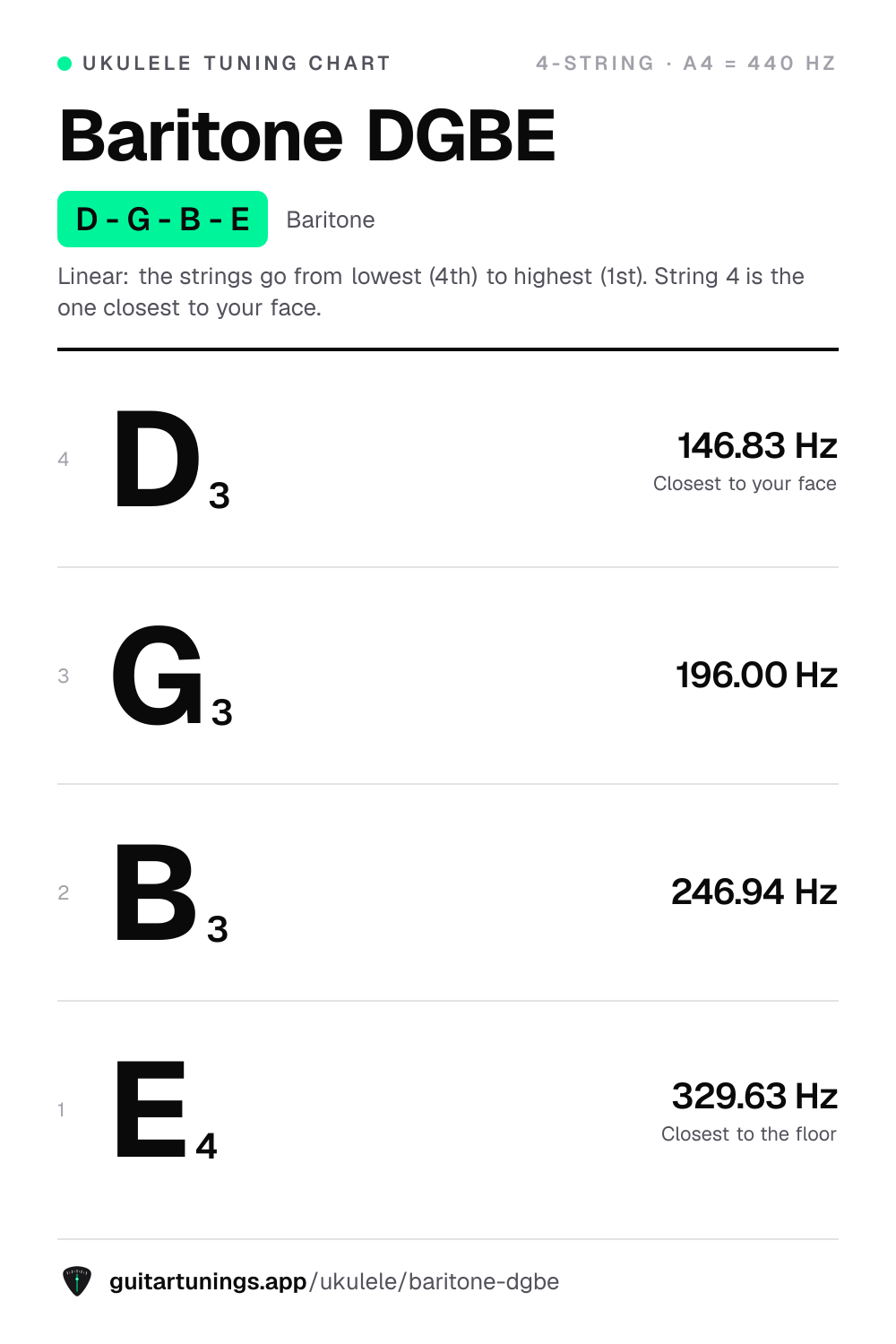
Baritone ukuleles are tuned D3 - G3 - B3 - E4, the same as the top four strings of a guitar. The tuning is linear (no re-entrant string), so the baritone sounds much deeper than other ukuleles. Guitar players can use their existing chord shapes on the top four strings.
| String | Note | Frequency |
|---|---|---|
| 4 | D3 | 146.83 Hz |
| 3 | G3 | 196.00 Hz |
| 2 | B3 | 246.94 Hz |
| 1 | E4 | 329.63 Hz |
Used on: Baritone
Printable chart (PNG)Teaching a class? Free resources for teachers →
Step by Step
- The 4th string (closest to your face) is D3 at 146.83 Hz, the 1st string is E4 at 329.63 Hz.
- Start with the 4th string and work towards the 1st: D, G, B, E.
- If you play guitar, you can also tune by ear from a guitar: the baritone matches the guitar's D, G, B and high E strings exactly.
- Some players tune baritones to GCEA with special strings. If yours has those strings, use the standard ukulele tuner instead.
Other Ukulele Tunings
Frequently Asked Questions
How is a baritone ukulele tuned?
D3 - G3 - B3 - E4, from the 4th to the 1st string. These are the same pitches as the four highest strings of a guitar in standard tuning.
Can I tune a baritone ukulele to GCEA?
Only with strings made for it. Standard baritone strings are too heavy to tune up to GCEA and would put a lot of stress on the neck. Several string makers sell GCEA sets for baritone scale length.
Do ukulele chord charts work on a baritone?
The shapes work, but they produce different chords. A shape that gives C on a GCEA ukulele gives G on a baritone. Use guitar chord shapes on the top four strings, or a baritone chord chart.
Can I use a guitar tuner for a baritone ukulele?
Yes. Any chromatic tuner works, and this page sets the targets to D3, G3, B3 and E4 so the string detection matches the baritone directly.