
How to Tune a Ukulele to D Tuning (ADF#B)
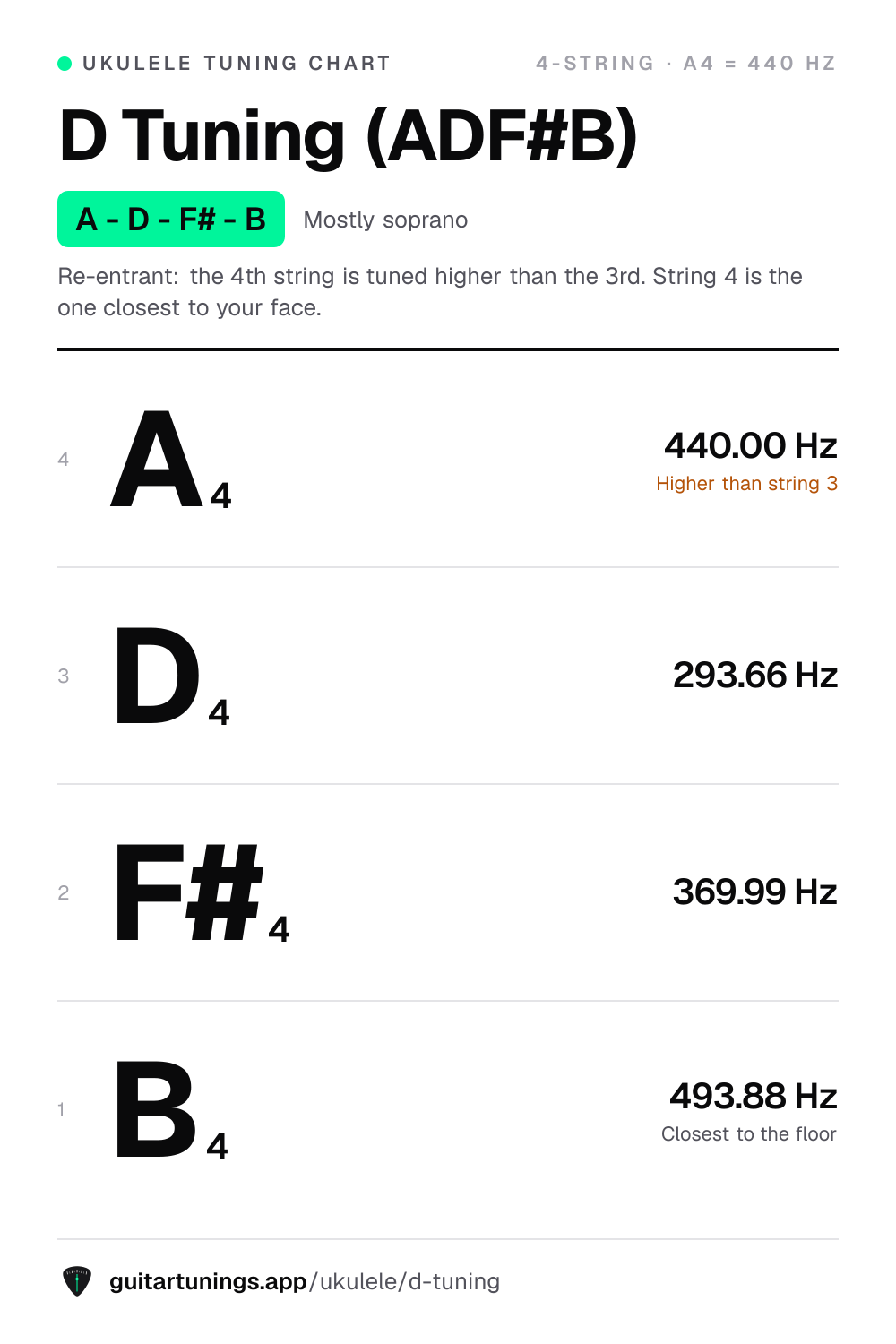
D tuning is A4 - D4 - F#4 - B4: every string sits one whole step above standard GCEA. It was the common ukulele tuning in the early and mid 20th century, and many vintage songbooks are written for it. The higher tension gives a soprano ukulele a punchier, brighter sound.
| String | Note | Frequency |
|---|---|---|
| 4 | A4 | 440.00 Hz |
| 3 | D4 | 293.66 Hz |
| 2 | F#4 | 369.99 Hz |
| 1 | B4 | 493.88 Hz |
Used on: Mostly soprano
Printable chart (PNG)Teaching a class? Free resources for teachers →
Step by Step
- Start in standard tuning (G-C-E-A).
- Raise each string by a whole step: G up to A, C up to D, E up to F#, A up to B.
- Tune slowly. Raising the pitch adds tension, and the 1st string at B4 is the most likely to snap.
- Chord shapes stay the same, but every chord sounds one whole step higher. A C shape now sounds as D.
Other Ukulele Tunings
Frequently Asked Questions
Why is it called D tuning?
Strumming the open strings in A-D-F#-B gives a D6 chord, just as standard G-C-E-A gives C6. The name refers to that open chord.
Is D tuning safe for my ukulele?
On most soprano ukuleles with regular strings, yes. It adds a moderate amount of tension. On concert and tenor ukuleles, use strings designed for D tuning or stay in standard tuning to avoid snapping the 1st string.
Is "My Dog Has Fleas" GCEA or D tuning?
The phrase "my dog has fleas" was originally sung to the open strings in D tuning. Today it is mostly used as a memory aid for the four string pitches of standard GCEA tuning.
Can I get D tuning with a capo instead?
Yes. A capo on the 2nd fret in standard tuning gives the same pitches (A-D-F#-B) without retuning, though the open-string sound is slightly different.